
For two decades, the greatest barrier to the creator economy wasn’t a lack of ideas—it was the “lens bottleneck.” Thousands of brilliant researchers, storytellers, and entrepreneurs stayed on the sidelines because they didn’t want their faces plastered across the internet or simply lacked the time for a 6-hour lighting and camera setup. In 2026, that barrier has been permanently dismantled. We have entered the era of the Faceless Brand, where privacy is no longer a limitation, but a strategic competitive advantage.
As a strategist who has navigated every “Ad-pocalypse” and algorithmic shift since 2005, I can tell you: we are in the golden age of high-yield content automation. According to recent industry data, faceless channels now account for 38% of all new monetized creator ventures, a staggering 217% increase since 2022. YouTube CEO Neal Mohan recently noted that Shorts alone have surpassed 200 billion daily views. The game has changed from “who can be the most famous” to “who can build the most efficient content pipeline.”
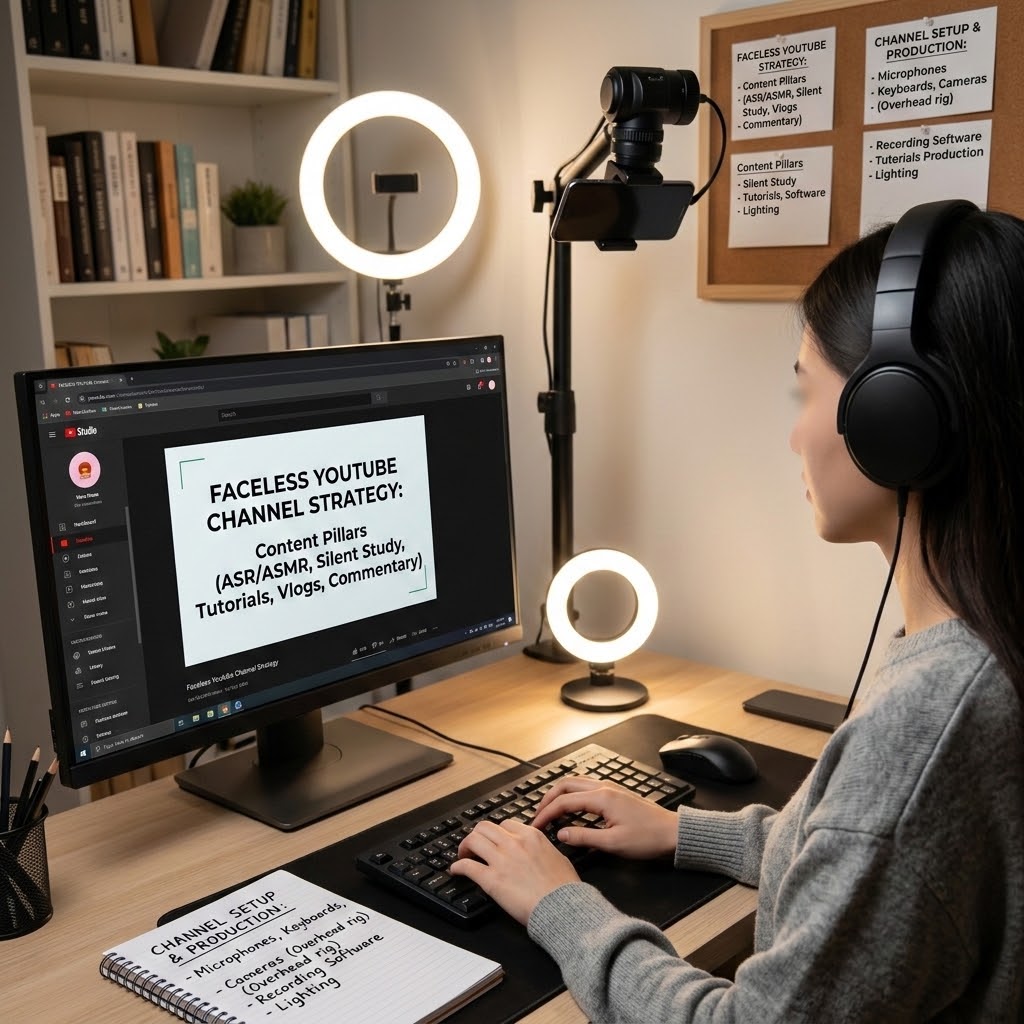
But let’s be clear: the “Cash Cow” era of lazy, spammy compilations is dead. YouTube’s updated 2026 “Gist Filter” and information-gain requirements mean you can’t just prompt your way to a paycheck. You must act as a Director, utilizing an AI tech stack to compress an 8-hour production day into an 80-minute sprint.
1. State of the Union: The 2026 Faceless Market Data
Understanding the market trajectory is vital for treating your channel as a long-term asset rather than a hobby. YouTube’s ad revenue hit $40.4 billion in late 2025—exceeding the combined revenue of traditional giants like Disney, NBCUniversal, and Warner Bros. Discovery. Goldman Sachs analysts project 2026 revenue to climb toward $46 billion as AI-optimized bidding matures.
The growth is driven by four structural shifts:
- Unlimited Scaling: Your channel isn’t capped by a human host’s health or availability.
- Instant Global Localization: A single concept can now be replicated in 32+ languages using AI voiceover and lip-sync swaps (e.g., ElevenLabs/HeyGen).
- Asset Replication: Successful formats can be duplicated across different niches by a single operator.
- The Privacy Mandate: 61% of new creators cite anonymity as their primary motivation.
Authenticity vs. Visibility: Interestingly, the Genspark Authenticity Study found that 86% of consumers perceive faceless content as authentic when the production quality is high. Viewers no longer care if they see a face; they care if they gain information.
2. High-Yield Niches: Finding the “Ghost Niches” and Micro-Nodes
In 2026, picking a niche based on “vibes” is a recipe for failure. You must look at the Google Knowledge Graph. Think of every topic as a “Node” in a massive library. If you target a saturated node like “Men’s Fashion,” you’re competing with millions. But if you move to an adjacent node—a Ghost Niche—like “Business Casual Haircuts” or “Mechanical Engineering Careers in Germany,” you find undersupplied demand.
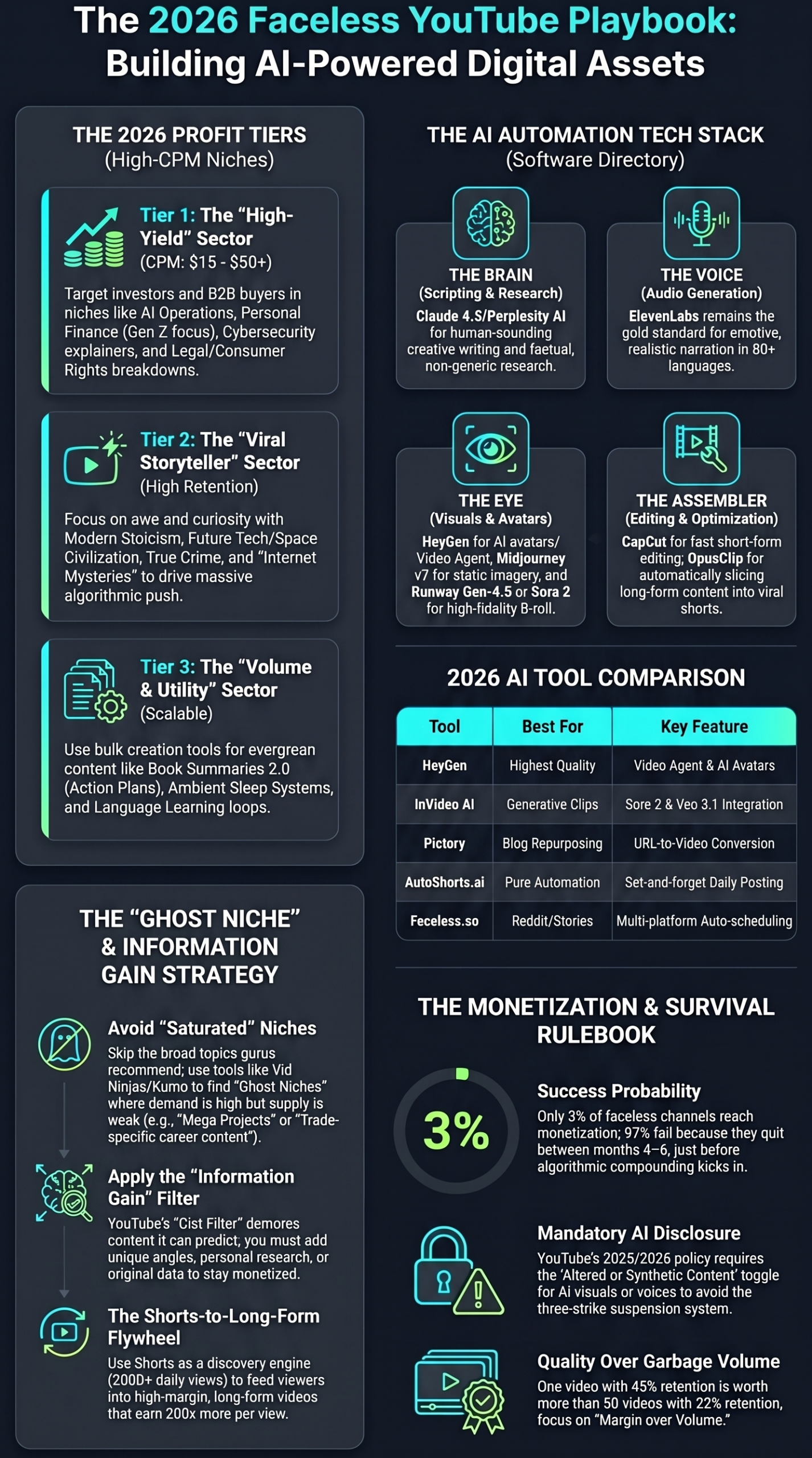
The “High-Yield” Tier ($15 – $50+ CPM)
These niches target professionals and investors. You need fewer views to earn a full-time income.
- AI Operations & SaaS Workflows: Tutorials on “Building Marketing Agents with Claude” or “Automating Excel with Python.”
- Global Personal Finance & Crypto: Breaking down the 2026 Crypto Cycle or ETF investing for Gen Z. Execution Note: Finance consistently holds CPMs of 20-50.
- Cybersecurity Explainers: Animating “How X Attack Happened.” This targets a massive professional audience with CPMs up to $30.
- Legal & Consumer Rights: Breaking down famous lawsuits or landlord-tenant law using kinetic typography.
The “Viral Storyteller” Tier (High Retention)
- Modern Stoicism: Ancient wisdom (Marcus Aurelius) paired with moody, cinematic Midjourney visuals.
- Future Tech & Space Civilization: Visualizing Earth in 2050 or the physics of warp drives.
- Internet Mysteries/Digital Archeology: Deep dives into “Lost Media” or the rise and fall of forgotten tech giants.
The “Volume & Utility” Tier (Scalable)
- Ambient Sleep Systems & Focus Audio: Channels like Adavia Davis are reportedly earning 40,000–60,000/month just from ambient sleep audio.
- Police Body Cam & True Crime: These niches leverage high-tension footage where the story is already built-in. Your job is “Dead Weight Removal”—cutting the footage to maintain a 60%+ retention rate.
- Luxury Real Estate: Using Midjourney + Runway Gen-3 to create “Future Architecture” concept tours.
2026 Niche Comparison Table
| Niche | Est. CPM | Competition | AI-Friendliness | Success Example |
| Personal Finance | 15–50 | High | Very High | 100k Subs = $10k/mo |
| AI / SaaS Ops | 15–25 | Medium | High | Vision Creative Labs |
| Cybersecurity | 20–30 | Low | High | N/A (Undersupplied) |
| Luxury Real Estate | 15–25 | Medium | Very High | “Future Architecture” |
| Niche History | 10–25 | Medium | Very High | The Infographics Show |
| Police Body Cam | 9–12 | Medium | Medium | Viral Breakdowns |
| Ambient/Sleep | 10–20 | Medium | High | Adavia Davis ($60k/mo) |
| Infrastructure | 6–7 | Low | High | “Mega Projects” |
3. The 2026 AI Tech Stack: From Timeline to “Scene-Based” Editing
The biggest technical shift in 2026 is moving away from “Timeline Editing” (like old-school Premiere Pro) toward Scene-Based Assembly. This is the secret to the 80-minute workflow. Tools like Frameloop and Vexub allow you to edit by scene; changing scene 3 doesn’t require re-rendering the whole project.

- The Brain (Research): Claude 4.5 is the gold standard for human-sounding creative writing. For factual rigor and the “Google Knowledge Graph” research, use Perplexity AI.
- The Voice (Audio): ElevenLabs or MixVoice provide emotive, realistic tones. For sleep channels, use slow, authoritative “Marcus Aurelius” styles.
- The Eye (Visuals):
- InVideo AI: The primary hub for Sora 2 and Veo 3.1 generative visuals.
- HeyGen: Best for “Video Agents”—using an AI avatar as a consistent visual anchor (this boosts retention by ~23%).
- Midjourney / Runway Gen-3: Essential for high-fidelity cinematic loops.
- The Assembler (Editing): Frameloop for scene-based control. CapCut Desktop for rapid Shorts formatting.
Efficiency Breakdown: 2022 vs. 2026
| Task | 2022 Workflow (Manual) | 2026 Workflow (AI Stack) |
| Scripting | 90 Mins | 20 Mins (Claude 4.5) |
| Voiceover | 60 Mins | 5 Mins (ElevenLabs) |
| Visual Sourcing | 90 Mins | 15 Mins (Sora 2/Veo 3.1) |
| Assembly/Edit | 4 Hours | 30 Mins (Scene-Based) |
| Thumbnail | 60 Mins | 10 Mins (GPT-4o Edit) |
| Total | ~8 Hours | ~80 Minutes |
4. Monetization and Policy: The 2026 Rules of the Road
YouTube didn’t ban AI; they banned “slop.” To monetize in 2026, you must understand the Gist Filter. If the algorithm can predict the next word in your script because it’s a generic copy of 1,000 other videos, your reach will be throttled.
The “Information Gain” Requirement
To pass the Gist Filter, you must provide Net Information Gain. This means adding original value:
- A unique angle (e.g., “Matching hair products to your genetics” vs. just “Best hair products”).
- Personal editorial judgment.
- High-fidelity, original AI visuals rather than overused stock footage.
The Three-Strike Disclosure System
Compliance is non-negotiable. If you use synthetic voices or realistic AI visuals, you must toggle the “Altered or Synthetic Content” box in YouTube Studio.
- Violation 1: Warning and mandatory educational module.
- Violation 2: 90-day monetization suspension.
- Violation 3: Permanent removal from the YouTube Partner Program (YPP).
The “Inauthentic Content” Trap
YouTube cracks down on three specific buckets:
- Verbatim Readings: AI reading news feeds or website text with zero original input.
- Mass-Produced Templates: Using the exact structure and B-roll for 50 identical videos.
- Scrolling Text: Videos with no narrative structure or meaningful commentary.
5. The 8-Month Roadmap: Surviving the “Quit Point”
Data from across the industry is brutal: only 3% of automation channels reach monetization. Why? Because 97% of creators quit during the Month 4-6 Quit Point.
In months 1–3, you are building your library and testing formats. Views will be low. Between months 4 and 6, it feels like nothing is happening—the revenue is zero, and the effort is high. This is where the “Survival Curve” happens. The algorithm is compounding your library in the background. Most monetized channels hit their “Algorithmic Inflection Point” between months 7 and 10.
The 30-Day Launch Blueprint
- Days 1-5: Choose a Ghost Niche. Use Perplexity to find “Nodes” with high search volume but low competition.
- Days 6-10: Set up your stack (ElevenLabs, Frameloop, Claude).
- Days 11-30: Ship 10 high-quality videos.
- The Flywheel: Use Shorts for discovery (to hit the 1,000 sub count) and Long-form for revenue (to build the 4,000 watch hours).
Monetization Math:
- Finance Channel (100k Subs): 5,000–10,000/mo in AdSense.
- History/Doc Channel (100k Subs): 1,500–6,000/mo in AdSense.
- Outlier Ceiling: DaFuq Boom (1.3M/mo) or **Daily Dose of Internet** (400k/mo).
6. Expert Tips for High-Yield Results
- Hook Engineering: The first 30 seconds are make-or-break. Use a “Curiosity Loop”—ask a question or present a visual mystery that won’t be solved until the end.
- The “Director” Mandate: Do not let AI post for you. Use AI to generate the components, but you must oversee the pacing. If a scene feels slow, cut it.
- Batch Production: Never produce one video at a time. Spend a Sunday morning batch-producing 10-15 videos. This “Asset Replication” is how professional operators manage 10+ channels simultaneously.
- OBS Loops for Sleep Channels: For ambient/sleep niches, use OBS to record a 10-minute high-quality gaming loop or a fireplace render, then use AI to extend and vary the audio for 8+ hour playback.
- Language Swapping: Once a video hits 50k views, use HeyGen’s Video Translator to swap the voiceover to Spanish or Hindi. You’ve already done the hard work; now capture the global market for $1/minute.
7. The Future of Faceless YouTube (2027–2033)
As we move toward 2030, the industry will transition from simple automation to Brand Architecture.
- Virtual Influencers: Expect to see AI avatars with consistent “personalities” and backstories.
- AI-Optimized Bidding: Ad revenue will become even more precise as YouTube’s AI matches your specific niche node with high-paying B2B advertisers.
- The Skill Shift: Technical prompting will become a commodity. Your value will lie in Editorial Judgment—knowing which stories are worth telling and how to structure a retention curve that beats the Gist Filter.
Here is a comprehensive list of profitable faceless AI YouTube channel ideas for 2026, broken down by category:
Finance & Business (High CPM)
- Personal Finance & Investing: Focus on targeted micro-demographics like Gen Z budgeting, saving money, passive income systems, debt payoff methods, or credit card reviews.
- B2B Software & SaaS Workflows: Create tutorials showing professionals how to use specific software or automate their workflows (e.g., “Automating Excel with Python” or CRM platform comparisons).
- Legal & Consumer Rights: Break down famous lawsuits, explain everyday rights (like tenant rights or what to do if arrested), or discuss small business legal requirements.
- Luxury Lifestyle & Real Estate: Showcase tours of “billionaire” lifestyles, mega-mansions, educational yacht content, or even obscure house listings targeted at wealthy finance advisors.
- Digital Marketing: Cover SEO tutorials, email marketing, and social media growth strategies.
Technology & AI
- AI Tool Reviews: Provide tight, opinionated reviews, tutorials, and comparisons of new AI tools.
- Cybersecurity Explainers: Use screen recordings to visually explain specific cyber attacks to a massive professional audience.
- Future Tech & Robotics: Visualize the future (e.g., Earth in 2050) or cover humanoid robotics news, such as updates on Tesla Optimus.
- Coding Tutorials: Focus on specific, modern tech stacks (e.g., building a SaaS in Bun and Hono) instead of saturated generic coding basics.
Documentary, History & True Crime
- Cinematic History: Create highly emotional, movie-like documentaries covering secret histories, spies, or conspiracy-style stories.
- Niche Modern History: Detail 1990s tech failures, the collapse of specific companies, or “Internet Mysteries” and digital archeology.
- True Crime & Police Footage: Combine archival photos, maps, and audio for crime explainers, or package raw police bodycam footage that features built-in emotional tension.
- Infrastructure & Mega-Projects: Explain the hidden dangers, risks, or massive scale behind bridges, tunnels, and roads.
- Geopolitics & Aviation: Utilize animated maps for geopolitical explainers or discuss why specific planes crashed throughout history.
Psychology, Philosophy & Self-Improvement
- Modern Stoicism: Mix ancient philosophy with modern struggles like digital detoxing or anxiety using moody, cinematic visuals.
- Psychology & “Dark History”: Explain human behavior, manipulation tactics, attachment styles, or historical tragedies.
- Action-Plan Book Summaries: Rather than just summarizing books, provide visual “action plans” so viewers get the results without the time commitment of reading.
Lifestyle, Health & Hands-Only Niches
- Micro-Niche Health & Wellness: Target highly specific groups with content like “senior health and longevity” or “sleep improvement for shift workers”.
- Hands-Only ASMR & Restoration: Create calm, slow videos focusing purely on hands performing meticulous tasks like bookbinding, mechanical watch repair, or cooking.
- Trade-Specific Careers: Highlight the day-to-day realities and salaries of specific jobs (e.g., “How much a HVAC tech actually makes in Texas”).
- AI Fitness Coaches: Document programmatic experiments like “AI generated my workout plan for 30 days”.
Curiosity, Entertainment & Education
- Creepy Sea Creatures: Use the natural horror and mystery of the ocean to generate high-retention videos.
- Trivia & Quizzes: Post rapid-fire engagement bait like “Guess the Flag” or “Would You Rather” questions.
- Language Learning: Create vocabulary loops, such as “Learn 100 Spanish Words While You Sleep” or specific native phrases.
- AI Animated Kids’ Stories: Re-imagine classic fables using AI text-to-video and claymation styles.
- Interesting Facts: Focus on micro-niches like space facts, weird history, or animal facts.
Passive “Always-On” Content
- Ambient Soundscapes & Sleep Systems: Generate medieval library ambience, rain sounds, or healing frequencies meant to run for 8+ hours in the background.
- Relaxing Gaming Compilations: Upload 90-minute soothing gameplay videos that viewers actively fall asleep to, earning high ad revenue through extended watch times.
The “Ghost Niche” Strategy Instead of simply copying saturated niches, you can also uncover “ghost niches”—topics completely ignored by the masses. By avoiding broad categories and analyzing related search clusters, you can find highly specific, uncrowded topics like “business casual haircuts for men,” lawnmower maintenance, or real estate trends.
8. Frequently Asked Questions (FAQ)
Is it safe to monetize AI-generated videos in 2026? Yes, provided you disclose synthetic content. YouTube explicitly allows AI monetization as long as the content isn’t “slop” (repetitive/low-effort). High-quality, disclosed AI content earns RPMs comparable to traditional content.
Do I own the copyright to AI visuals? Tools like HeyGen, InVideo, and Vexub provide commercial usage rights. However, under current law, pure AI-generated visuals may not have full copyright protection. Focus on the original editorial structure of your video, which is copyrightable.
How much does it cost to start? A professional AI stack (ElevenLabs, Claude, InVideo/Frameloop) costs between $80 and $150 per month. This replaces a 2022-era video team that would cost $2,000+ monthly.
Can I get banned for using AI voices? No. You only risk a ban if you fail to disclose synthetic voices or if you use AI to impersonate real people without consent. High-quality, emotive voices from ElevenLabs are the industry standard.
How many videos do I need to see results? Most channels see the “algorithmic inflection point” after 30 to 50 videos. If you quit at video 15, you are statistically quitting right before the compounding starts.
Which is better: Shorts or Long-form? In 2026, you need both. Shorts provide the “Discovery Engine” (viral reach), while Long-form provides the “Revenue Engine” (high CPM AdSense). Channels using both grow 41% faster.
What is the “Three-Strike System”? It’s YouTube’s compliance enforcement. 1st: Warning. 2nd: 90-day monetization suspension. 3rd: Permanent removal from the Partner Program. It’s triggered by failing to disclose AI content or uploading “Inauthentic/Repetitive” content.
Will viewers trust a channel without a face? Yes. 86% of consumers find faceless content authentic if the production is high quality. Trust is now built through Information Gain, not just seeing a human face.
How much time should I commit? With 2026 tools, you can manage a high-quality channel in 5-10 hours per week if you utilize batch production.
What niche has the highest CPM? Currently, Global Finance, AI/SaaS Operations, and Cybersecurity lead the pack with CPMs ranging from $20 to $50+.
9. Conclusion: Your Magnum Opus Starts Today
Building a faceless YouTube channel in 2026 is no longer about “hacking” the algorithm—it is about building a legitimate digital asset. By selecting a high-yield Ghost Niche, leveraging a scene-based AI stack, and strictly adhering to disclosure policies, you can build a scalable business that operates while you sleep.
Your Next Three Steps:
- Map Your Node: Use Perplexity to find a micro-niche (e.g., “Homeowner Law for Landlords”) instead of a broad category.
- Test the Stack: Sign up for Frameloop or InVideo and produce one 60-second draft using an AI voice.
- Commit to the 50-Video Sprint: Do not check your revenue dashboard until you have 50 high-quality videos live.
The creator economy is a $250 billion market heading toward a trillion. The most successful operators of the next decade won’t be those with the most famous faces, but those with the most efficient pipelines. Start building yours.