
Do you run a YouTube channel, or are you currently thinking about starting one? If so, have you caught up on the latest YouTube 2026 updates that are completely transforming how creators make and share content?
Have you noticed the major changes to AI labels yet? YouTube is now automatically detecting and applying permanent transparency labels to videos that feature “significant photorealistic AI”—and these labels now sit right below the video player for everyone to see. Have you ever checked your YouTube Studio recently to ensure the automated system hasn’t incorrectly slapped an AI label on your latest upload?
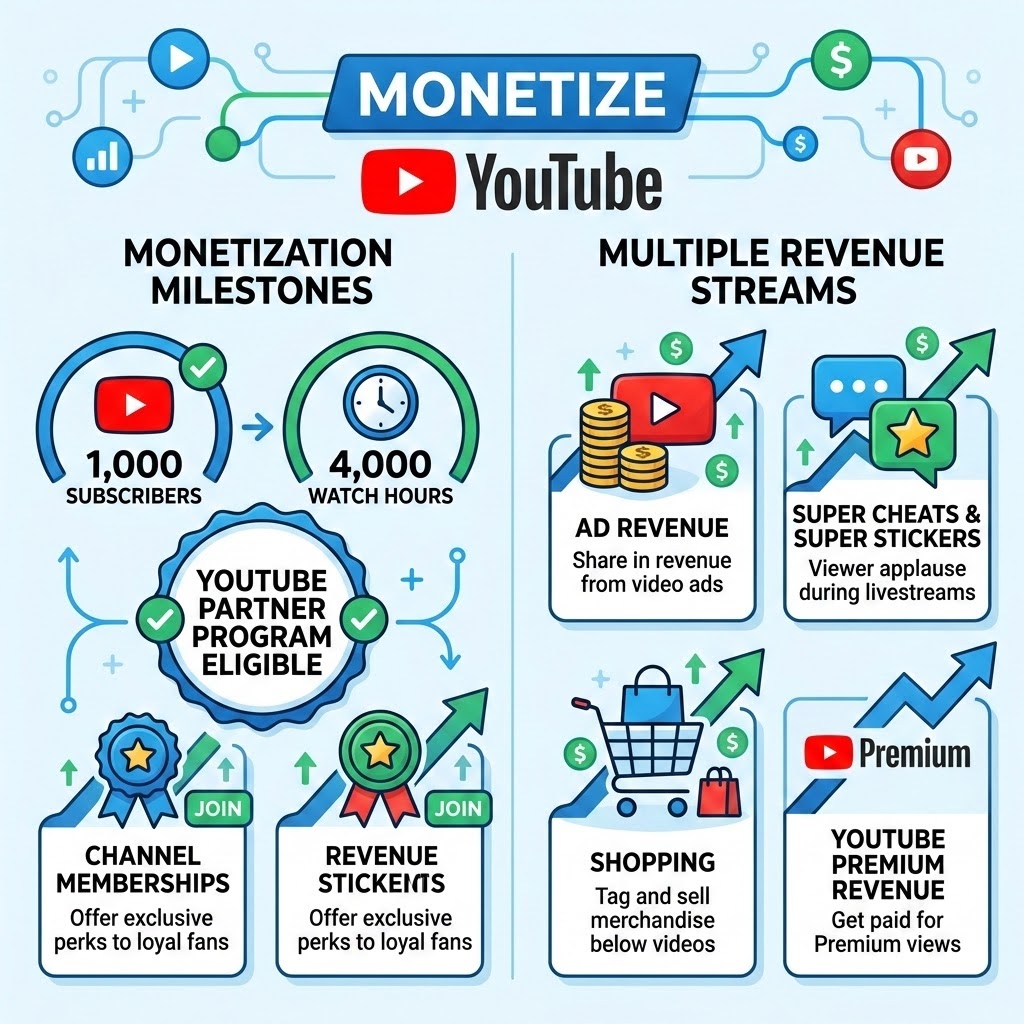
What about your channel’s earning potential—have you checked your “Earn” tab lately? Did you know that the barrier to entry is lower than ever, allowing you to unlock early monetization features like Super Thanks and Channel Memberships with just 500 subscribers and 3,000 watch hours (or 3 million Shorts views)?
Are you taking advantage of the massive push for short-form content? Have you tried out the new AI-powered Shorts editing tools like “Reimagine,” or used the “Make me move” feature to instantly animate your still photos into a video?
Have you ever thought about taking your channel global to reach viewers in other countries? Did you know you can now use AI auto-dubbing that actually matches your lip movements to a foreign language, and even upload different multi-language thumbnails so viewers across the world see a customized image.
SEO Strategy Overview
1. Introduction: The Morning the Algorithm Changed
Imagine waking up to find your flagship video—the one you spent weeks meticulously color-grading—has been automatically “slapped” with a prominent AI disclosure label you didn’t apply. This is the hallmark of the YouTube 2026 updates, where the platform has pivoted from guessing to “reading” digital signatures. In this landscape, understanding AI transparency labels and the new YouTube monetization 2026 rules isn’t just about compliance; it is about survival. As YouTube executes a strategic “pincer maneuver” to compete with TikTok’s viral speed and Netflix’s high-fidelity polish, creators must master YouTube SEO trends like semantic search and the Consensus Layer to maintain authority. We have entered the “Human-First” era of YouTube, where visibility is dictated by searchable trust and technical metadata as much as creative vision.
2. The New AI Transparency Mandate: Labels, Detection, and UI Redesign
In 2026, viewer trust is the platform’s most vital currency. Renee Ritchie, YouTube’s Head of Editorial, defines the current philosophy as “context at a glance.” This has led to a total overhaul of how viewers interact with content and how the system verifies authenticity.
The May 27, 2026, AI Labeling Policy
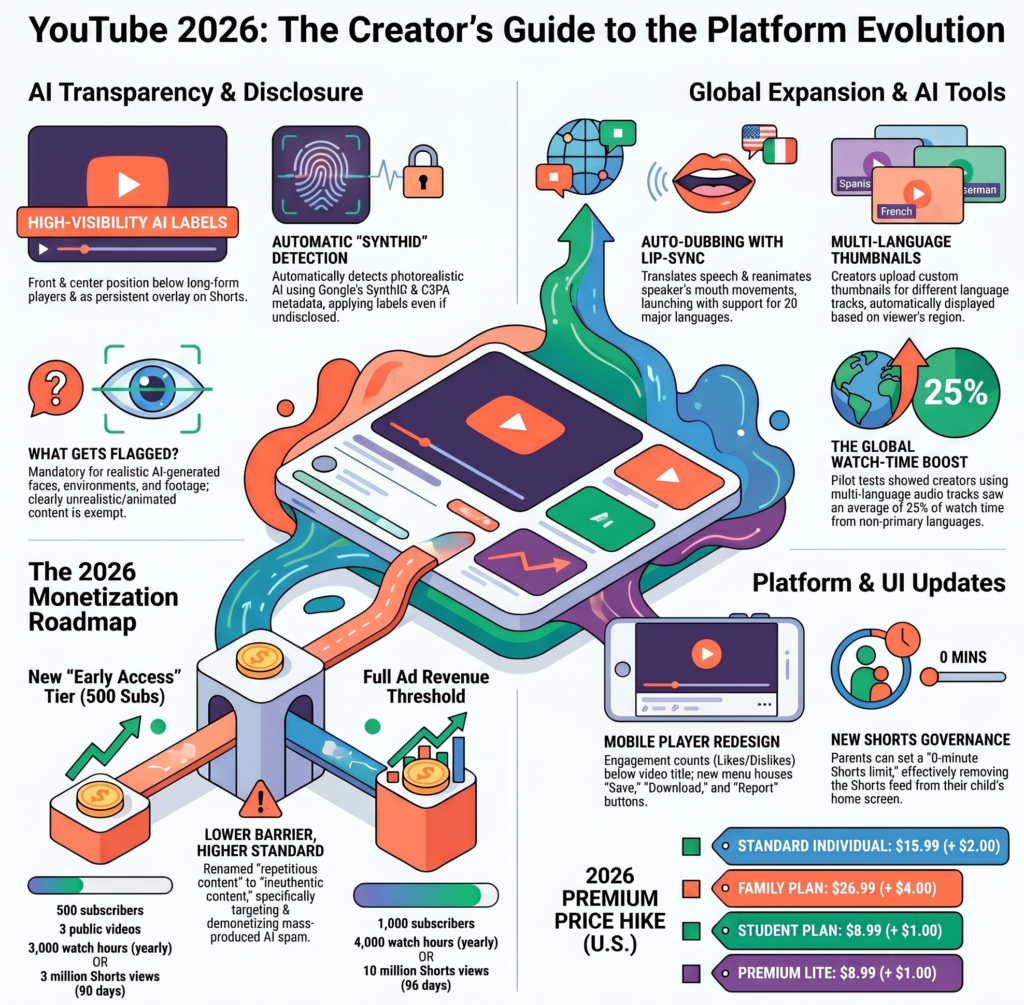
YouTube now mandates disclosure for any realistic AI-generated or significantly modified content. These labels have moved from the description to the most visible real estate on the screen:
- Long-form Videos: The label appears directly below the player, positioned above the description.
- YouTube Shorts: The disclosure appears as a clear overlay directly on the video feed.
Technical Detection: SynthID and C2PA
YouTube is no longer reliant on creator honesty; it is reading the file’s DNA:
- SynthID: An invisible, indelible watermark stamped into content created via Google AI tools (like Veo 3 Fast) at the point of generation.
- C2PA Metadata: Advanced manifest data that proves a file is fully generative. If these tags are present, the label is permanent and cannot be removed.
- Automatic “Slapping”: If photorealistic faces, environments, or footage are detected without disclosure, the system applies the label automatically. Creators can only appeal this in Studio if the system misidentifies non-AI content.
UI Redesign: The Search for Clarity
The mobile player has seen its most significant redesign in years. The Like, Dislike, Share, and Ask buttons now feature updated icons, and engagement counts (likes/views) have moved from beside the buttons to a position below the video title, next to the channel name. This shift emphasizes the “Consensus Layer”—the idea that your authority is verified by how the broader web perceives your brand entity.
3. The Creator’s AI Toolkit: From “Reimagine” to “Ask Studio”
The boundary between technology and artistry has dissolved. In 2026, AI is positioned as a bridge, not a replacement.
Native Production Tools
YouTube has integrated high-end generative models directly into the workflow. Veo 3 Fast and Dream Screen allow for instantaneous background generation, while the “Reimagine” tool for Shorts lets creators transform raw camera roll footage into compelling first drafts or add motion to still images.
Global Reach and Conversation
The most transformative tool in the kit is Ask Studio. No longer a “future” experiment, it now features Conversation History, allowing creators to use the AI as a permanent research assistant to find search gaps in their community data. Additionally, a new physical “Ask” button in the mobile player allows viewers to query the video content in real-time.
Global Reach Tools: Strategic Impact
| Feature | Strategic Impact |
| Auto-dubbing with Lip Sync | Reanimates speaker lip movements to match translated audio (20+ languages); eliminates “uncanny valley” distractions. |
| Multi-Language Thumbnails | Pair specific language tracks with custom, localized thumbnails (e.g., Arabic right-to-left) to boost regional CTR. |
| Expressive Captions | AI-enhanced style and tone in captions; essential for building EEAT signals in technical or trust-heavy niches. |
The Strategist’s “Catch”: While AI Lip Sync is powerful, synthetic voices still lack the emotional nuance required for high-retention storytelling. Professional dubbing (as seen with “BeMultilingual” partners) remains the gold standard for maintaining a high Average Viewer Duration (AVD).
4. Monetization 2.0: The Lowered Barrier and High-Quality Bar
YouTube has lowered the entry threshold for the YouTube Partner Program (YPP) to aggressively court emerging talent, while simultaneously launching a massive crackdown on “AI Slop.”
The 2026 Tiered Requirements
- Early Access Tier (500 Subs): Requires 3 public videos in 90 days and 3,000 watch hours (or 3M Shorts views). This unlocks Fan Funding (Super Thanks, Memberships) and YouTube Shopping.
- Full Ad Revenue Tier (1,000 Subs): Requires 4,000 watch hours (or 10M Shorts views). This is the only way to unlock AdSense and Premium revenue splits.
The “MilX” Approach to Cash Flow
Savvy creators are no longer waiting for the 30-day AdSense cycle. Using services like MilX, creators are accessing “Active Funds”—advances of up to 6 months of future income—to fund gear upgrades or brand campaigns immediately.
Global Expansion (April 2026 Rollout)
Monetization is going global faster than ever. In April 2026, Live Stream Gifts and Jewels expanded to six new high-growth markets: Australia, Indonesia, New Zealand, Taiwan, and Thailand.
The Crackdown: YouTube is purging inauthentic content. In May 2026 alone, 4.7 billion views of low-effort AI-generated “slop” were wiped. Staying in YPP now requires passing human reviews that check for original storytelling and lived experience.
5. YouTube is the New TV: The Living Room Revolution
CEO Neal Mohan’s 2026 priority is clear: “Creators are the new Prime Time.” YouTube is now the #1 streaming destination in the U.S., surpassing traditional cable and Netflix in watchtime.
- The Sports Powerhouse: YouTube TV has launched the YouTube TV Sports Plan, featuring FS1, NBC Sports Network, and ESPN Unlimited, alongside customizable multiview.
- Super Resolution AI: To ensure content looks professional on 80-inch screens, YouTube now automatically upscales 240p or 720p content to 1080p HD.
- Frictionless TV Commerce: The “2-click TV checkout” with Google Pay allows viewers to buy products from a creator’s YouTube Shopping shelf using their remote or a QR code.
6. A Safer Sandbox: Protecting Kids and Teens
With 93% of teens using YouTube for learning, the platform has prioritized parental empowerment over simple restriction.
- Shorts Feed Limit: In an industry first, parents can set the daily Shorts timer to zero, effectively removing the Shorts feed from a child’s home screen.
- Simplified Switcher: The Smart TV UI now features an “Account Switcher” that clearly flags members of a Premium Family plan, making it easier to maintain age-appropriate viewing environments.
- Creator Advice: To stay “Family-Safe” and maintain AdSense eligibility, avoid misleading clickbait and ensure all AI-assisted educational content is transparently labeled.
7. The Future of YouTube: 2026–2031
The next five years will see YouTube move from a video repository to a comprehensive demand capture infrastructure.
Key Future Trends
- The Rise of Creator Studios: Moving past “UGC,” creators are purchasing Hollywood-sized lots to produce studio-grade “Must-See TV.”
- The Consensus Layer: This is the new frontier of SEO. Your rankings will be dictated by how often your brand is cited as a credible “entity” on off-platform sources like podcasts, news sites, and high-authority blogs.
- Semantic SEO Mastery: Optimizing for the intent of a spoken question rather than just keyword strings.
Skills to Develop Now:
- Natural Language Prompting: For cleaning transcripts to assist the algorithm’s “reading” of your expertise.
- Entity Building: Ensuring your name is linked to your niche across the entire web to strengthen EEAT signals.
8. Expert Tips for Better Results
- Adopt Topic Clustering: Never upload an isolated video. Build a system: one pillar long-form video, three supporting Shorts, and a community poll.
- The 7-Second Rule: You have exactly 7 seconds to state the problem and the promised outcome. If you use a long intro, your retention—and your ranking—will tank.
- Clean Captions for Semantic Search: AI auto-captions often mangle technical terms. Manual cleanup is essential so the Consensus Layer can correctly index your expertise for semantic queries.
9. Advantages and Disadvantages of the 2026 Ecosystem
| Advantages | Disadvantages |
| Faster Monetization: Fan funding access at just 500 subscribers. | Premium Price Hikes: Standard Premium has risen to **15.99/month** (26.99 for Family). |
| Global Localization: Lip Sync and multi-language thumbnails simplify international expansion. | Stricter AI Labeling: Automatic “slapping” of labels can affect initial viewer trust if not managed. |
| Living Room Scale: “Super Resolution” and 50MB thumbnails make your content TV-ready. | High Quality Floor: “AI Slop” crackdown means the bar for “originality” is much higher. |
10. Frequently Asked Questions (FAQ)
1. Does the AI label hurt my views? No. YouTube has officially stated that AI labels are for viewer information only and do not negatively impact the recommendation algorithm or monetization.
2. How do I appeal a wrong label? If the system incorrectly identifies your video as AI, you must manually update the status in YouTube Studio. It will not resolve automatically.
3. What is the new cost of YouTube Premium? As of June 2026, the U.S. price is $15.99/month. The Annual plan is $159.99, and the Family plan is $26.99.
4. What is the “Consensus Layer”? It is an SEO concept where YouTube’s algorithm looks for brand mentions and citations across the wider web (blogs, news, podcasts) to verify that you are a credible authority on a topic.
5. How does the “Shorts Feed Limit” work? It’s a parental control that allows users to set a timer for Shorts. If set to 0, Shorts are removed from the home feed entirely.
6. Can I still monetize if I use AI voices? Yes, provided the content is original and provides value. However, synthetic voices generally see lower retention than human voices.
7. What are the requirements for “Early Access” monetization? 500 subscribers, 3 public uploads in 90 days, and either 3,000 watch hours in a year or 3 million Shorts views in 90 days.
8. What happens if I don’t disclose AI use? YouTube’s systems (SynthID/C2PA) will likely detect it and apply the label automatically. Repeated failure to disclose can lead to penalties under the “Inauthentic Content” policy.
11. Conclusion: Building Searchable Trust
Success on YouTube in 2026 is no longer about “gaming the algorithm”—it’s about Searchable Trust. As the platform merges the functions of a search engine, a TV network, and a shopping mall, your value is defined by your clarity and your credibility.
Actionable Next Steps:
- Audit for C2PA Compliance: Ensure your production workflow correctly handles metadata to avoid incorrect AI “slaps.”
- Validate Entity Clarity: Search your brand name across the web. If you aren’t being cited in podcasts or blogs, your Consensus Layer signals are weak.
- Own a Commercial Question: Identify one high-intent search query (e.g., “How to protect CAD IP”) and build a 30-day topic cluster around it to dominate that niche.
YouTube is the new prime time. The stage is set; it’s time to build your studio.